
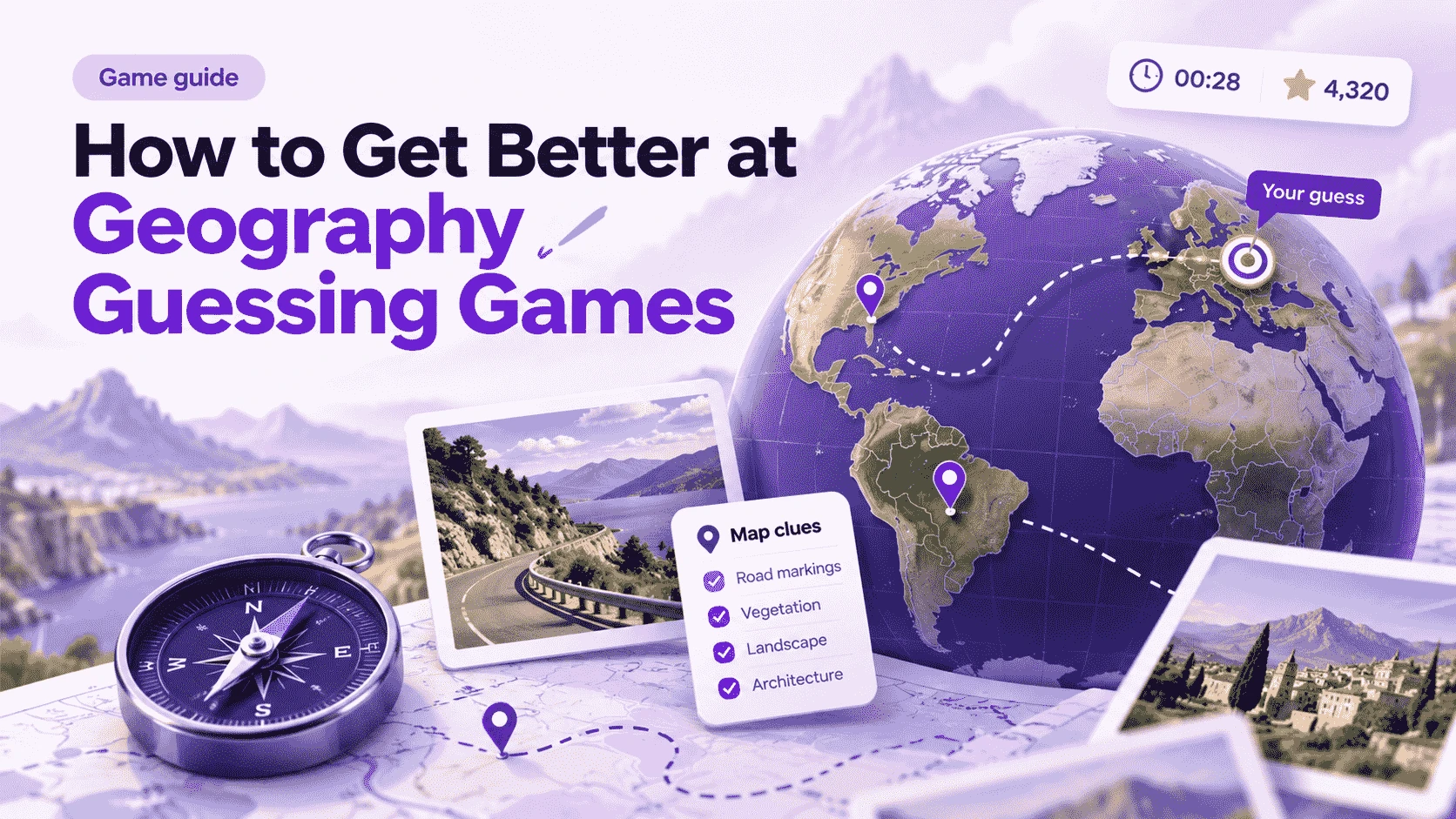
How Do You Get Better at Geography Guessing Games?
Getting better at geography guessing games is less about memorizing every country on Earth and more about learning how to notice the right clues. A road line, traffic sign, language, mountain range or even the type of vegetation around you can dramatically narrow down where a location might be.
Beginners often look at a scene and try to guess the country immediately. Stronger players do something different: they eliminate possibilities. They start with broad clues, narrow the location to a continent or region, and then use smaller details to make their final guess.
The good news is that this is a skill you can train. Once you develop a repeatable process for reading a location, geography guessing games become far less random and much more strategic.
This guide explains the most useful geography guessing techniques, what clues to check first, common mistakes to avoid and how to practice so your accuracy improves over time.
1. Start With the Biggest Clues First
One of the biggest mistakes in geography guessing games is focusing on tiny details too early. Before trying to identify a specific road sign, utility pole or building style, first understand the overall environment.
Ask yourself where in the world the scene could realistically exist. You are not trying to identify the exact country yet. Your first job is to eliminate large parts of the map.
For example, a tropical road lined with palms immediately creates a different set of possibilities from a dry desert highway or a road surrounded by snow-covered mountains.
Think from large clues to small clues. The more possibilities you eliminate early, the easier the rest of the round becomes.
- Is the environment tropical, dry, temperate or cold?
- Is the area flat, mountainous or coastal?
- Does the location look urban, suburban or rural?
- Which side of the road is traffic using?
- What kind of road infrastructure is visible?
- What languages or writing systems appear nearby?
2. Check Which Side of the Road People Drive On
The side of the road used by traffic is one of the fastest clues available in many geography guessing games.
Look at moving vehicles, parked cars, road markings and intersections. Determining whether traffic drives on the left or right can immediately remove a large number of possible countries.
For example, countries such as the United Kingdom, Australia, Japan, India, South Africa and New Zealand use left-side traffic. Much of continental Europe and the Americas use right-side traffic.
Do not rely on a single parked vehicle, because it may be positioned unusually. Look for several pieces of evidence before making the clue part of your final decision.
3. Learn to Read Roads and Road Markings
Roads contain far more information than most new players realize. The color and style of center lines, edge markings, pedestrian crossings, reflectors and roadside posts can help distinguish one country from another.
Instead of simply seeing a road, start treating the road itself as evidence.
Pay attention to whether the center line is white or yellow, whether outside edge lines are present, whether markings are solid or broken and what roadside barriers or reflector posts look like.
You do not need to memorize every road system immediately. Start by recognizing broad regional patterns and gradually add country-specific details as you play more rounds.
- Center-line color
- Edge-line color and thickness
- Solid versus broken lines
- Road reflectors
- Bollards and roadside posts
- Guardrails
- Pedestrian crossings
- Road surface and general road quality
4. Use Language Without Needing to Speak It
Language is one of the most powerful geography clues, and you do not need to be multilingual to use it.
Start by identifying the writing system rather than trying to translate every word. Latin, Cyrillic, Arabic, Greek, Thai, Japanese, Korean and other scripts can quickly narrow down the possible region.
When the text uses the Latin alphabet, look for distinctive letters, accents and spelling patterns. Small details such as ñ, ø, å, ä, ł or other characters can provide useful hints.
Place names, road signs, advertisements, business names and web addresses can all provide additional evidence. Even when you cannot understand the meaning, recognizing the structure of a language is extremely useful.
- Identify the writing system first
- Look for unusual letters or accents
- Check place names on directional signs
- Notice repeated words on public signs
- Look for country-specific website domains when visible
- Use language as one clue rather than relying on it alone
5. Pay Attention to Road Signs
Road signs can reveal both obvious and subtle information about a location.
The text on a sign may identify a city or region, but even a sign without readable words can help. Countries use different combinations of sign shapes, border colors, warning symbols, route shields and directional sign designs.
Train yourself to notice the complete sign rather than only reading the text. The shape, background color and mounting style can sometimes be as useful as the words written on it.
Over time, repeated exposure makes certain sign systems immediately recognizable.
6. Look at License Plates
Even when license plate text is blurred or impossible to read, the plate itself can still provide useful clues.
Look at its overall color, length, shape and whether the front and rear plates appear different. Some regions use visually distinctive plate formats that become easy to recognize after enough practice.
License plates work best as supporting evidence. Combine them with traffic direction, road markings, signs and landscape before committing to a country.
- Plate color
- Long versus compact plates
- Front and rear plate differences
- Colored strips or side markings
- Whether plates are mounted on both ends of the vehicle
7. Read the Landscape Like a Clue
Landscape recognition is one of the most enjoyable parts of geography guessing games, but it can also cause bad guesses when players rely only on intuition.
Instead of thinking that a place simply 'looks European' or 'feels South American,' break the landscape into observable characteristics.
Look at mountains, soil, vegetation, farming patterns, coastlines, climate and settlement density. Each clue individually may be weak, but several matching clues can point strongly toward a particular part of the world.
Remember that landscapes frequently cross national borders. Vegetation should narrow your options rather than automatically determine your answer.
- Mountain shape and elevation
- Soil color
- Tree and plant types
- Dryness or humidity
- Agricultural patterns
- Coastlines and water
- Density of buildings
- Overall climate
8. Study Architecture and Building Styles
Buildings can reveal a surprising amount about where you are.
Roof materials, window designs, building colors, construction methods, fences and the spacing between homes can all vary by climate and region.
A Mediterranean village, Scandinavian neighborhood and Southeast Asian roadside settlement may all contain houses, but the materials and construction styles can look completely different.
Architecture becomes particularly useful when there are no readable signs nearby. Rather than memorizing individual buildings, learn to recognize combinations of features.
- Roof shape and material
- Brick, stone, concrete or timber construction
- Window and balcony styles
- Fences and property boundaries
- Building density
- Relationship between buildings and the road
9. Learn Basic Vegetation Patterns
You do not need to become a botanist to use vegetation in geography games.
Start with broad categories. Are you looking at palms, evergreen forests, dry scrub, tropical vegetation, grasslands or agricultural fields?
Vegetation works particularly well when combined with climate and terrain. Palm trees alone could indicate many countries. Palm trees combined with a dry volcanic landscape, particular road markings and Spanish-language signs create a much stronger set of clues.
This is an important principle throughout geography guessing: combinations are more reliable than individual clues.
10. Notice Utility Poles and Roadside Infrastructure
Once you become comfortable with the obvious clues, start paying attention to the infrastructure most people ignore.
Utility poles, streetlights, transformers, guardrails, bollards and road barriers can have distinct regional patterns.
Experienced players often use these details when a landscape could belong to several different countries. You do not need to memorize hundreds of pole types at the beginning. Simply start noticing them.
The more rounds you play, the more frequently you will recognize infrastructure that you have encountered before.
11. Use the Sun Carefully
The position of the sun can sometimes help you estimate which hemisphere you are in.
But this clue should be used carefully. Camera orientation, season, latitude and time of day can make sun-based guesses less straightforward than they initially appear.
Treat the sun as supporting evidence rather than your only clue. If several environmental clues suggest the Southern Hemisphere and the sun position supports that conclusion, your confidence becomes stronger.
12. Combine Clues Instead of Trusting One Detail
The most important skill in geography guessing games is learning to combine evidence.
One clue can easily mislead you. A language might appear because of tourism. A vehicle might be imported. A plant might grow in several continents.
But when several independent clues point toward the same place, your guess becomes much more reliable.
Imagine you find left-side traffic, English road signs, dry vegetation, distinctive road markings and a landscape that looks Australian. None of those clues alone proves the location, but together they create a strong case.
Think like a detective. Your goal is not to find one magical clue. Your goal is to build the best explanation for everything you can see.
13. Use the Elimination Method
When you cannot identify the location immediately, stop asking 'Where is this?' and ask 'Where can this not be?'
Elimination makes difficult rounds far easier.
Suppose you know the traffic direction, climate, writing system and road style. Even if none of those gives you the answer directly, together they may eliminate most of the map.
Strong geography guessing is often a process of reducing possibilities until only a few reasonable options remain.
- Start with the hemisphere or broad climate zone
- Narrow the location to a continent or broad region
- Use traffic and language to eliminate countries
- Use roads and infrastructure to compare the remaining possibilities
- Use landscape and architecture as confirmation
- Make your final guess based on the strongest combination of evidence
14. Do Not Overthink Every Round
Sometimes your first strong conclusion is better than the complicated theory you create after spending another minute searching for clues.
If four or five clues strongly suggest the same country, do not abandon that answer because one small detail looks unfamiliar.
Good geography players know when they have collected enough information. Learning when to stop searching is especially important in timed games.
15. Review Your Mistakes After Every Game
Playing more rounds helps, but simply playing again and again is not the fastest way to improve.
The most valuable moment often comes after you discover the correct location.
Before moving immediately to the next round, compare your guess with the answer. Look back at the location and ask what clue you missed.
Maybe the road markings were distinctive. Perhaps a language clue was visible on a shop. Maybe the vegetation should have ruled out your original guess.
This simple review turns every wrong answer into a geography lesson.
- Where did I guess?
- Where was the actual location?
- Which clue made me choose the wrong country?
- Which clue should I have noticed?
- Would I recognize this location pattern next time?
A Simple Practice Routine for Geography Guessing Games
You do not need to spend hours studying geography every day. A short but deliberate practice routine can be much more effective.
Try playing several rounds while focusing on one category of clues. One session could focus on road markings. Another could focus on language. Another could focus on vegetation and climate.
Once those individual skills become familiar, start combining them during normal games.
- Play 5 to 10 rounds
- Use the same clue checklist every round
- Write down countries you repeatedly confuse
- Review every incorrect guess
- Learn one new clue from each mistake
- Revisit difficult regions later
Geography Guessing Checklist
When a new round begins, having a fixed checklist prevents you from randomly scanning the screen. Use the same order repeatedly until the process becomes automatic.
- 1. Landscape and climate
- 2. Driving side
- 3. Road markings
- 4. Language and writing system
- 5. Road signs
- 6. License plates
- 7. Architecture
- 8. Vegetation
- 9. Utility poles and roadside infrastructure
- 10. Smaller regional clues
Common Geography Guessing Mistakes
Improving is not only about learning more clues. It is also about removing habits that produce inconsistent guesses.
- Guessing from the general 'vibe' of a location
- Relying on only one clue
- Trying to memorize too many advanced clues at once
- Ignoring road markings
- Assuming similar landscapes belong to the same country
- Failing to review incorrect guesses
- Searching for an exact city before identifying the country
- Changing a strong answer because of one uncertain detail
Frequently Asked Questions About Geography Guessing Games
Below are quick answers to some of the most common questions players have when trying to improve.
- How can I get better at geography guessing games? Learn a repeatable clue-reading process and practice identifying traffic direction, road markings, language, signs, landscape, architecture and infrastructure.
- What should I look for first in a geography guessing game? Start with broad clues such as climate, terrain and driving side before moving to smaller clues like road signs and utility poles.
- Do I need to memorize every country? No. Learning recognizable patterns and eliminating impossible locations is generally more useful than trying to memorize everything.
- What are the best clues for guessing a country? Driving side, language, road markings, road signs, license plates, architecture, vegetation and roadside infrastructure are among the most useful categories.
- How do good players guess locations so quickly? Repetition makes common clue combinations recognizable. Experienced players often follow a mental checklist instead of examining every object individually.
- Can geography games actually improve geography knowledge? Yes. Regular play can expose you to countries, cities, landscapes, languages and regional differences that you might rarely encounter otherwise.
Final Thoughts
Getting better at geography guessing games does not require memorizing the entire world.
The biggest improvement comes when you stop making random guesses and start treating every scene as a collection of evidence.
Look at the road. Check the traffic direction. Study the language. Notice the vegetation, buildings and landscape. Then combine those clues before placing your guess.
At first, the process may feel slow. After enough practice, many of these observations become automatic. A road line, sign shape or landscape that once meant nothing may eventually be enough to point you toward the correct part of the world.
Most importantly, review the rounds you get wrong. Every missed location gives you one more pattern to recognize the next time you play.
The goal is not to know every place on Earth. It is to become better at reading the clues the world gives you.
Have a correction or a question? Contact WebRiseHub.