
What Makes a Browser Survival Game Work?
A good survival game begins with a simple question: what will you do when the game stops telling you exactly what to do?
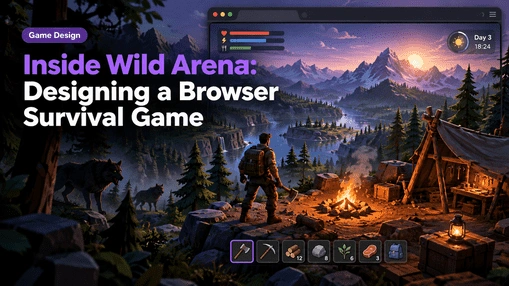
That question sits at the center of Wild Arena. The player enters an unfamiliar environment with limited resources and has to explore, gather supplies, manage risks and decide what matters most for survival.
But designing a survival game for the browser creates an interesting challenge. The experience needs enough depth to make exploration and survival meaningful, while remaining fast enough to start playing without a huge download or complicated setup.
That means every system has to earn its place. Gathering, crafting, health, exploration and environmental danger cannot exist simply because other survival games have them. They need to work together to create decisions.
This is a look inside the thinking behind Wild Arena and the design principles that can make a browser survival game engaging.
1. Start With a Strong Survival Game Loop
Most survival games are built around a repeating loop. The player explores, finds resources, uses those resources to improve their situation and then ventures farther into the world.
The individual actions can be simple. What makes them interesting is how they connect.
Finding wood is not particularly exciting on its own. It becomes meaningful when wood can build a shelter, fuel a fire or help craft something the player needs before night arrives.
A strong survival loop continually gives the player a reason to make one more decision.
- Explore the environment
- Discover useful resources
- Gather what you can carry
- Craft or build useful items
- Manage health and other survival needs
- Prepare for environmental threats
- Travel farther into the world
- Discover new risks and opportunities
2. Design for the Browser First
A browser survival game should not feel like a large desktop game squeezed into a web page.
Browser players often expect to enter the experience quickly. Long introductions, complicated menus and too many systems appearing at once can create friction before the player has even discovered what makes the game interesting.
Wild Arena therefore needs to communicate its basic interactions quickly. Movement should feel understandable. Resources should be recognizable. Important information should be visible without overwhelming the screen.
The goal is not to remove depth. It is to reveal that depth gradually.
- Fast entry into gameplay
- Clear controls
- Readable interface elements
- Limited early-game complexity
- Gradual introduction of mechanics
- Responsive performance
- Short feedback loops
3. Make Survival About Decisions, Not Just Resources
A survival game becomes much more interesting when resources create choices rather than chores.
Imagine that the player finds enough material to make only one important item. Should they improve their shelter? Craft a tool? Save the material for later? Prepare for an approaching threat?
There is no interesting decision if resources are unlimited and every item can be created immediately.
Scarcity creates tension. But scarcity also needs balance. Too many resources remove the challenge, while too few can make the game feel unfair.
The ideal situation is one where players frequently have enough to survive, but not always enough to do everything they want.
4. Reward Exploration
Exploration is one of the most important parts of a survival game because it gives players a reason to leave safety behind.
The player should regularly wonder what might be beyond the next path, forest, hill or unexplored part of the map.
But exploration needs a purpose. A larger map does not automatically create a better survival game.
New areas should introduce something meaningful: different resources, environmental conditions, landmarks, threats or strategic opportunities.
Good exploration creates a constant trade-off between curiosity and safety.
- Rare resources
- New terrain
- Useful landmarks
- Safer locations
- Dangerous areas
- Hidden supplies
- Environmental clues
- Unexpected encounters
5. Keep Resource Gathering Simple but Meaningful
Resource gathering is a familiar survival mechanic, but it can quickly become repetitive.
The solution is not necessarily to add dozens of resource types. More resources can actually make the game harder to understand without making it more interesting.
Each important resource should have a clear purpose.
Wood might support building and fire. Stone could enable stronger tools. Food supports survival. Other materials can unlock more advanced options.
When players understand why something matters, discovering that resource feels useful instead of arbitrary.
6. Make Crafting Solve Problems
Crafting works best when players create an item because they understand the problem it solves.
A tool could make gathering faster. A shelter could provide protection. A fire might help the player through dangerous conditions.
This creates a natural relationship between exploration and progression: explore to find materials, use materials to solve problems and then use those solutions to explore farther.
Instead of showing players a huge crafting list immediately, recipes can become relevant as new survival problems appear.
- Tools improve efficiency
- Shelters create safety
- Storage expands resource management
- Equipment prepares players for danger
- Upgrades open new possibilities
7. Balance Risk and Reward
One of the most useful tools in survival game design is the risk-versus-reward decision.
Imagine that the player can see valuable resources in the distance, but reaching them means leaving the safety of camp as daylight begins to disappear.
The game does not need to tell the player what to do. The situation itself creates the decision.
Should you leave now? Wait until morning? Carry more supplies? Risk losing what you already collected?
Moments like these make survival games memorable because the player's own choices create the story.
8. Use Time to Create Pressure
A changing world can turn ordinary actions into strategic decisions.
A day-and-night cycle is particularly useful because it gives players an understandable form of pressure. Daylight can represent opportunity: explore, gather and prepare. Night can introduce uncertainty or increased danger.
The important design principle is that time should affect player behavior.
If day and night look different but nothing about the player's decisions changes, the system is mostly visual. If darkness changes exploration, safety or preparation, time becomes part of the survival strategy.
9. Let the Environment Communicate
Survival games do not need to explain everything through text boxes.
The environment itself can teach the player.
A visible campfire suggests safety. A distant structure encourages exploration. A dark forest can signal uncertainty. A trail might quietly guide the player toward something important.
Environmental communication is particularly valuable in a browser game because it reduces the need for long tutorials.
Ideally, players should learn some of the game's rules simply by observing the world.
10. Keep the Survival UI Easy to Read
Survival games need to communicate a lot of information, but showing everything at once can make the interface feel like a dashboard instead of a game.
The most important information should be understandable at a glance.
Players need to know their current condition, what they are carrying and whether an immediate problem requires attention.
Secondary information can appear only when it becomes relevant.
- Health
- Important survival status
- Equipped item
- Quick-access inventory
- Resource quantities
- Time or environmental state
11. Make Difficulty Feel Fair
Survival games need danger, but difficulty should make players reconsider their decisions rather than feel that the game randomly punished them.
When something goes wrong, the player should ideally understand why.
Maybe they explored too far without supplies. Maybe they failed to prepare before night. Maybe they spent an important resource too early.
Those failures are valuable because they teach the player something that can change the next attempt.
Fair difficulty creates a powerful reaction: 'I know what I'll do differently next time.'
12. Let Players Feel Their Progress
Survival progression does not always need traditional levels or experience points.
Progress can be visible directly in the world.
At the beginning, the player may have almost nothing. Later, they have tools, supplies, knowledge of the environment and a place that feels safer than where they started.
That contrast creates a strong sense of achievement.
The player's knowledge is also part of progression. Learning where resources appear, which areas are dangerous and how to prepare efficiently makes the player stronger even when their character statistics have not changed.
13. Create Systems That Produce Player Stories
Some of the best moments in survival games are not scripted.
A player travels farther than planned, realizes night is approaching, runs low on supplies and has to decide whether to continue toward an unknown shelter or turn back.
Another player may spend too many resources building early and then struggle to prepare for a later threat.
These situations become personal stories because they emerge from interacting systems rather than predetermined sequences.
Designing systems that collide in interesting ways can create more memorable moments than trying to script every possible experience.
14. Performance Is Part of Browser Game Design
For a browser game, technical performance directly affects game design.
A beautiful environment loses much of its impact if movement feels sluggish or loading interrupts exploration.
Assets, effects, animations and world complexity therefore need to be balanced against responsiveness.
Optimization should not be treated only as something that happens after the game is finished. It is part of deciding what the game should be from the beginning.
The best browser survival experience is not necessarily the one with the most visual detail. It is the one that delivers enough atmosphere while remaining responsive and accessible.
Key Principles for Designing a Browser Survival Game
Looking at the systems together reveals a few principles that shape the Wild Arena experience.
- Get the player into the game quickly
- Teach through interaction whenever possible
- Make resources create meaningful choices
- Give players reasons to explore
- Use crafting to solve real survival problems
- Balance scarcity without creating frustration
- Make danger understandable
- Keep important information easy to read
- Use the environment to communicate
- Design systems that interact with each other
- Treat browser performance as part of the experience
- Give players room to create their own survival stories
Frequently Asked Questions About Browser Survival Games
Here are answers to some common questions about survival game design and browser-based games.
- What is a browser survival game? A browser survival game is a survival experience designed to run through a web browser, allowing players to explore and interact with the game without installing a traditional desktop game.
- What makes a good survival game? Strong survival games combine exploration, limited resources, progression, risk and meaningful player decisions into a repeatable gameplay loop.
- Why is resource management important in survival games? Limited resources force players to prioritize. Deciding what to gather, use, craft or save creates strategy.
- How do you make a survival game interesting? Give players meaningful choices, reward exploration, create understandable risks and allow multiple systems to interact in ways that produce unexpected situations.
- Why are browser games challenging to design? Browser games need to balance visual quality and gameplay complexity with loading speed, responsiveness, device compatibility and accessibility.
- Do survival games need complicated crafting systems? No. A smaller crafting system can work well when every item has a clear purpose and solves a problem the player understands.
Final Thoughts
Designing Wild Arena is not simply about adding the familiar ingredients of a survival game.
The challenge is making those ingredients depend on each other.
Exploration leads to resources. Resources create crafting decisions. Crafting helps the player prepare for danger. Danger makes preparation meaningful. And every decision gives the player another reason to explore.
For a browser survival game, all of this also has to happen without burying the player under complicated controls, long tutorials or unnecessary friction.
That is ultimately what Wild Arena is designed around: a world that is easy to enter but gives players increasingly difficult decisions once they are inside.
Because the most interesting survival question is rarely just whether you can stay alive.
It is what you decide to do when you do not have enough time, resources or information to do everything.
Have a correction or a question? Contact WebRiseHub.